14.6
Davisson and Germer Experiment
Dual Nature of Radiation and Matter · Maharashtra HSC
Theory
Purpose
De Broglie's hypothesis needed experimental proof that a particle can show a wave property. Since the size of atoms and their spacing in crystals is of the order of a few angstrom — the same order as the de Broglie wavelength of an electron of a few eV — Davisson and Germer anticipated that electrons scattered by the atoms of a crystal would interfere and show diffraction effects. Diffraction is a property of waves, so observing it with electrons would settle the question.
Experimental arrangement
- The whole set-up is enclosed in an evacuated chamber.
- An electron gun produces electrons by heating a tungsten filament F using a battery B.
- The electrons are accelerated through vacuum to a desired velocity by applying a suitable accelerating potential across a cylindrical anode, which also collimates them into a focused beam.
- This beam falls on a nickel crystal and is scattered in different directions by the atoms of the crystal. Electrons here take the place of light waves.
- The scattered electrons are detected by an electron detector, and the current is measured with a galvanometer.
- The detector can be moved on a circular scale, so the scattering angle — the angle between the incident and the scattered electron beams — can be varied and the intensity of the scattered beam measured for different values of .
The diagram in words
Draw the electron gun at the top left: a filament F with its heating battery B, enclosed in a cylindrical anode connected to a high tension supply, with the electron beam emerging as a narrow collimated line directed downwards onto a nickel crystal at the bottom centre. From the crystal, draw a scattered beam going up to the right at an angle from the incident direction, into a detector mounted on a circular scale drawn as an arc centred on the crystal. Connect the detector to a galvanometer. Enclose everything in a rectangle labelled "evacuated chamber", and mark the angle between the incident and scattered beams.
Observations
- The scattered intensity was not uniform in all directions, as classical theory had predicted it would be.
- The intensity pattern resembled a diffraction pattern, with peaks corresponding to constructive interference and troughs to regions of destructive interference.
- No electrons were found in certain directions, because of destructive interference, while in other directions the maximum number of electrons was found, because of constructive interference.
- Since diffraction is a property of waves, this implied that the electrons formed a diffraction pattern on scattering, and hence that particles can show wave-like properties.
The quantitative result
- Davisson and Germer varied the accelerating potential from V to V and observed a peak in the intensity of the scattered electrons at a scattering angle of for a potential of V. This peak was the result of constructive interference of the electrons scattered from different layers of the regularly spaced atoms of the nickel crystal.
- From the de Broglie relation for an accelerated electron, for V,
- From the electron diffraction measurements, the wavelength of the matter waves associated with the electrons was found to be nm.
- The two values of , one from the experimental diffraction result and one from the theoretical de Broglie relation, were in close agreement.
Importance
- The Davisson and Germer experiment substantiated de Broglie's hypothesis of wave-particle duality and verified his relation quantitatively.
- It established for the first time that a material particle, the electron, has an associated wave and can be diffracted.
- G. P. Thomson reached the same conclusion in England in 1928 by diffracting electrons through thin metal foils. De Broglie received the Nobel Prize in Physics in 1929, and Davisson, Germer and Thomson shared it in 1937.
- The same effect can be shown in a laboratory electron diffraction tube: electrons from a heated filament cathode are accelerated by a large potential difference towards a positive electrode, pass through a thin sheet of graphite, are diffracted by its atomic layers and form diffraction rings on a phosphor screen. Increasing the voltage increases the electron energy, shortens the wavelength and so shrinks the radius of the rings.
Wave-particle duality of matter (textbook section 14.7)
- Material particles show wave-like nature under certain circumstances. This phenomenon is known as the wave-particle duality of matter.
- Frequency and wave number are used to describe waves in classical theories, while mass and momentum are used to describe particles. Wave-particle duality implies that all moving particles have an associated frequency and an associated wave number, and all waves have an associated energy and an associated momentum.
- We come across the wave-particle duality of matter, that is quantum behaviour, only when dealing with microscopic objects, of size about m or smaller. The small order of magnitude of sets the scale at which quantum phenomena manifest themselves.
- The photon picture allows transfer of energy and momentum in the same manner as in Newtonian mechanics, and the wave nature does not modify that. Whenever wavelengths are small compared with the dimensions of slits or obstacles, or are not measurable, Newtonian mechanics can be used.
- In conclusion, for both electromagnetic radiation and atomic and sub-atomic particles, the particle nature is dominant during their interaction with matter, while the wave nature is dominant while they travel through space, particularly when their confinement is of the same order of magnitude as their associated wavelength.
Related applications from the same section
- Electrons are bound inside a metal and need energy at least equal to the work function to escape. The physical way that energy is supplied distinguishes the processes: thermionic emission (heating to about C to supply thermal energy), field emission (a strong electric field of about at a metal tip to supply electrical energy) and photoelectric emission (shining ultraviolet or visible radiation to supply light energy).
- Electron microscope. The resolution of a microscope is limited by the wavelength of the probe used: the shorter the wavelength, the smaller the limit of resolution and the better the resolution. An electron behaves as a wave and its wavelength is far shorter than that of visible light; an electron beam accelerated to several keV has a de Broglie wavelength much smaller than one angstrom, so an electron microscope resolves several hundred times better than an optical microscope.
- Further advantages of an electron microscope: electrons do not penetrate matter as visible light or X-rays do; electron beams are more easily produced and controlled by electric and magnetic fields than electromagnetic waves; and electrons can be focused, just as light is focused by lenses.
- It was proposed in 1925 that atoms in solids can act as diffraction centres for electron waves and give information about the structure of a solid, just as X-rays do. The first electron microscope was developed in Berlin in 1929.
Theory Questions Asked on This Subtopic
Real board questions. Answers are at the end of the page.
- 1
Draw a neat labelled diagram of Davisson and Germer experiment.
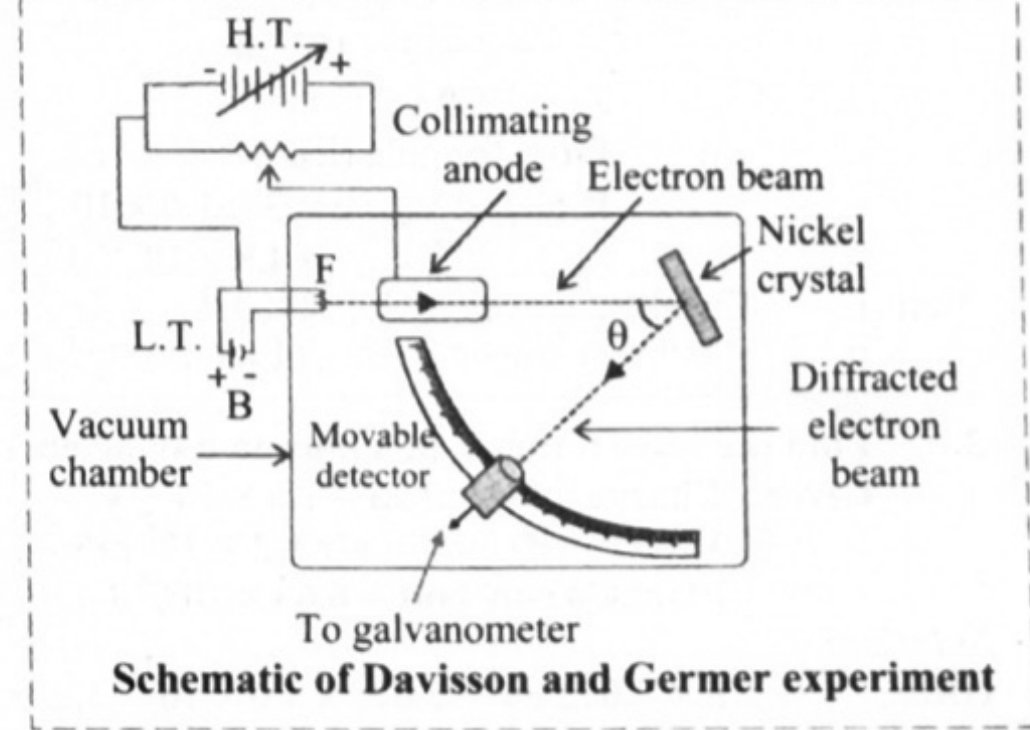 Maharashtra HSC board question — asked in March 2010Answer 1 ↓
Answers & Solutions
Work the questions above first, then check yourself here. Each answer is set out the way it should be written in the paper.
The question is a real board question. Its answer and working are ours — this paper was published without an official answer key.
Labelled diagram of the Davisson and Germer experiment
- The schematic of the apparatus is as shown.
Parts to be labelled
Label Part F Tungsten filament of the electron gun B Battery that heats the filament Anode Cylindrical anode that accelerates and collimates the electrons Nickel crystal Target on which the electron beam is scattered Detector Electron detector, movable on the circular scale theta () Scattering angle, between the incident and the scattered beams G Galvanometer that measures the detector current Working in brief
- i. The whole set-up is enclosed in an **evacuated chamber**. The electron gun produces electrons by heating the tungsten filament F with the battery B.
- ii. The electrons are accelerated to the desired velocity by a suitable potential applied across the **cylindrical anode**, which also collimates them into a focused beam.
- iii. The beam falls on a **nickel crystal** and is scattered in different directions by the atoms of the crystal.
- iv. The scattered electrons are received by a **detector** that can be moved on a **circular scale**, so that the intensity can be measured for different values of the scattering angle . The current is read on the **galvanometer G**.
- v. The scattered intensity was not uniform in all directions, as classical theory predicted; it showed peaks and troughs, that is, a **diffraction pattern**, which is a property of waves.
- vi. Varying the accelerating potential from 44 V to 68 V, a sharp peak was found at for V. The de Broglie relation gives
while the diffraction measurement gave nm. The close agreement substantiated de Broglie's hypothesis and verified his relation.