4.5
Magnetic Field on the Axis of a Circular Current Loop
Moving Charges and Magnetism · CBSE
Theory
The set-up
- A circular loop of radius carries a steady current . Place it in the – plane with its centre at the origin , so the -axis is the axis of the loop. The field is wanted at the point on the axis, at distance from .
- Take a conducting element on the loop; let be the vector from the element to , with .
The derivation CBSE sets (5 marks)
- By Biot-Savart's law, The angle is because every element of the loop is perpendicular to the vector from it to an axial point: lies in the – plane while lies in a plane containing the -axis, so .
- is perpendicular to the plane of and . Resolve it into a component along the axis and a component perpendicular to the axis.
- The perpendicular components cancel in pairs: the contribution of any element is cancelled by that of the diametrically opposite element. Only the axial components survive, and they all add.
- Writing for the angle whose sine projects onto the axis, (equivalently, in NCERT's labelling of the same projection).
- Hence
- and are constants round the loop, so the integral is just :
- In vector form , directed along the axis, its sense given by the right-hand thumb rule.
- For a tightly wound coil of turns, multiply by : .
Special cases
- At the centre, :
- Far away on the axis, : drop from the denominator, the field of a magnetic dipole.
- The ratio the board likes: with at the centre and on the axis at ,
Diagram in words
- Draw the loop edge-on as an ellipse with its centre and the axis running horizontally to . Mark from to a current element at the top of the loop, and from that element to .
- At draw perpendicular to , and resolve it into along the axis and perpendicular to it. Draw the diametrically opposite element's contribution too, so the two perpendicular components visibly cancel.
- Field lines of the loop: closed curves passing through the centre along the axis, straight and closely spaced there, bending round outside the loop and closing on themselves — the same pattern as a short bar magnet, with the face from which the lines emerge acting as the north pole.
Right-hand thumb rule for a loop
- Curl the palm of the right hand round the wire with the fingers pointing along the current; the outstretched thumb gives the direction of on the axis.
- Note this is a *different* rule from the one for a straight wire, where the thumb goes along the current and the fingers curl with the field. Fingers and thumb swap roles.
Combining loops — the recurring board problem
- Two identical coils lying in perpendicular planes with a common centre produce fields at that centre which are mutually perpendicular, so they combine as
- Radius , currents and : , at to the field of the stronger coil.
- Radius , currents and : , making with the field of the coil.
- Two small identical loops with perpendicular axes meeting at , each centre a distance from : each contributes and, being perpendicular, they give at to each.
Composite arrangements at a point
- Break the conductor into parts, compute each contribution with the right standard result, fix each direction with the right-hand rule, then add as signed quantities (or as vectors).
- Straight wire bent into a loop in the middle: at the centre , the straight parts give and the loop gives , opposite in sense, so
- Semicircular arc of and radius together with a small loop of and radius : outwards, inwards, so directed into the plane of the paper.
Results to carry away
- Axial field ; centre ; far field .
- .
- Perpendicular coils at a common centre: add by Pythagoras.
Theory Questions Asked on This Subtopic
Real board questions. Answers are at the end of the page.
- 1
Two identical circular loops and , each of radius carrying current are kept in perpendicular planes such that they have a common centre (loop oriented vertically, loop horizontally). Find the magnitude and direction of the net magnetic field at point .
- 2
Two very small identical circular loops, (1) and (2), carrying equal currents are placed vertically (with respect to the plane of the paper) with their geometrical axes perpendicular to each other, meeting at a common point , each loop's centre being at a distance from along its own axis. Find the magnitude and direction of the net magnetic field produced at the point .
- 3
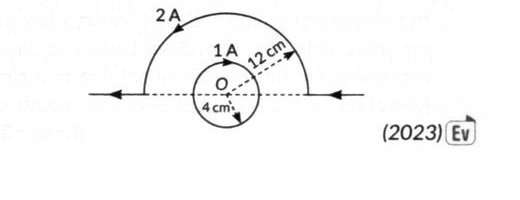
A current carrying circular loop and a straight wire bent partly in the form of a semicircle are placed as shown in the figure. Find the magnitude and direction of net magnetic field at point .
- 4
(a) State Biot-Savart's law and express this law in the vector form. (b) Two identical circular coils, and each of radius , carrying currents 1 A and A respectively, are placed concentrically and perpendicular to each other lying in the XY and YZ planes. Find the magnitude and direction of the net magnetic field at the centre of the coils.
- 5
Two identical loops and each of radius 5 cm are lying in perpendicular planes (loop vertical, loop horizontal) such that they have a common centre . Find the magnitude and direction of the net magnetic field at the common centre of the two coils, if they carry currents equal to 3 A (loop ) and 4 A (loop ) respectively.
- 6
Use Biot-Savart law to derive the expression for the magnetic field on the axis of a current carrying circular loop of radius . Draw the magnetic field lines due to circular wire carrying current .
- 7
Two identical coils and each of radius are lying in perpendicular planes such that they have a common centre. Find the magnitude and direction of the magnetic field at the common centre of the two coils, if they carry currents equal to and respectively.
- 8
A circular loop of radius carries a current . Obtain an expression for the magnetic field at a point on its axis at a distance from its centre. OR Write, using Biot-Savart law, the expression for the magnetic field due to an element carrying current at a distance from it in a vector form. Hence derive the expression for the magnetic field due to a current carrying loop of radius at a point distant from its centre along the axis of the loop.
Numericals
Every numerical set on this subtopic. Full working is at the end of the page.
- 9
The magnetic field at the centre of a current carrying circular loop of radius is . The magnetic field at a point on its axis at a distance from the centre of the loop is . Then the ratio is
- (a)
- (b)
- (c)
- (d)
- (a)
- 10
A current flows through a long straight conductor which is bent into a circular loop of radius in the middle (the straight portions continue on either side, and the centre of the loop is point ). The magnitude of the net magnetic field at point will be
- (a)
Zero
- (b)
- (c)
- (d)
- (a)
Answers & Solutions
Work the questions above first, then check yourself here. Each answer is set out the way it should be written in the paper.
Let us assume that the current in loop flows such that there is equal current flow in each parallel wire of loop (i.e. the two halves of loop , as seen from the point of interest which lies along its own diameter/axis in the plane, produce cancelling fields there). Since the point of interest (the common centre itself, lying in the plane of loop along a diameter direction relevant here) is such that the magnetic field due to loop 's own plane geometry at effectively vanishes by the stated symmetry, the magnetic field due to at is zero: . Now, current in loop is , so magnetic field due to current at the centre of loop : Hence, total magnetic field at , directed perpendicular into the plane of loop .
The magnetic field at an axial point due to a circular loop is given by , where is the current, is the radius of the loop and is the distance of from the centre of the loop. Since , and are the same for both loops, the magnitude of will be the same for each and is given by The direction of the magnetic field due to loop (1) will be away from along its axis, and that due to loop (2) will be towards along its own (perpendicular) axis. Since and are perpendicular to each other (loop axes are at 90°), The magnitude of the net magnetic field is given by directed at 45° to each of and (i.e. bisecting the angle between the two loop axes).
The magnetic field induction at point due to the semicircular arc (current 2 A, radius cm) is T The direction of , according to the right hand rule, is normal to the plane of paper, directed outwards. The magnetic field induction at the centre of the smaller circular loop (current 1 A, radius cm) is given by T The direction of , according to the right hand rule, is perpendicular to the plane of paper and directed inwards. Now, net magnetic field, T (inwards)
(a) A current carrying wire produces a magnetic field around it. Biot-Savart's law states that the magnitude of intensity of small magnetic field due to current carrying element at any point at distance from it is given by , where is the angle between and . In vectorial form: (b) Field due to current in coil (in the XY plane, current 1 A) is ; field due to coil (in the YZ plane, current A) is (since A, A) , and the resultant magnetic field is directed in the XZ plane.
Magnetic field induction due to vertical loop (current A) at the centre is: (with cm m) Magnetic field induction due to horizontal loop (current A) at the centre is: Since and are perpendicular to each other, the resultant magnetic field induction at the centre is: T T Direction of resultant magnetic field: [using ratio ] or So the resultant magnetic field makes an angle 37° with (the field of the 3 A loop).
Consider a circular loop of radius carrying current , and a point on its axis at distance from the centre . By Biot-Savart's law, small field due to element at : , since everywhere on the loop (where ). The component (perpendicular to the axis) due to a current element is cancelled by the equal and opposite component of the diametrically opposite current element, whereas the components (along the axis) add up. So, net field at due to entire loop is , directed along the axis: (a) towards the coil if current in it is anticlockwise, or (b) away from the coil if current is clockwise (as seen from that side) — [book states: towards the coil if current is clockwise, away if anticlockwise, per the sign convention used]. The magnetic field lines due to a circular wire carrying current form closed loops that pass through the centre along the axis (straight and dense near the centre) and curve around and close up outside the loop, resembling those of a bar magnet's field, being directed by the right-hand thumb rule.
Since both coils are inclined to each other at an angle of 90°, the magnitude of their resultant magnetic field at the common centre will be (using and , perpendicular to each other) The direction of the resultant field is at an angle given by Hence, the direction of the magnetic field will be at an angle 30° to the plane of loop (i.e. 30° from 's direction, towards 's direction).
By Biot-Savart's law, the small magnetic field due to a current element of the circular coil of radius at point (on the axis, distance from centre) is , since , where . The component (perpendicular to axis) cancels for diametrically opposite elements; the axial components add up. , directed along the axis (towards the coil if current is clockwise, away if anticlockwise, as seen from the point of observation).
Answer: (a) Magnetic field due to loop at its centre: ...(i) Magnetic field due to a current carrying loop, on its axis at distance : Putting : ...(ii) Dividing (i) by (ii):
Answer: (d) Magnetic field due to straight wire at : (out of the page, say) Magnetic field due to circular wire (loop) at : (into the page)