5.2
The Bar Magnet
Magnetism and Matter · CBSE
Theory
What the board asks here
- One mark: properties of field lines, torque and force on a dipole aligned with the field, why poles cannot be separated.
- Three marks: the four properties of magnetic field lines; work done and torque numericals.
- Five marks: show that a current-carrying solenoid behaves as a small bar magnet and derive its far axial field; magnetic moment of a coil; equilibrium of a pivoted magnet.
The bar magnet as a dipole
- Iron filings sprinkled on a glass sheet over a short bar magnet settle into a pattern with two centres of concentration. The pattern mimics the magnetic field lines and shows the magnet behaves as a magnetic dipole with a north pole and a south pole, exactly as an electric dipole has and .
- Freely suspended, the pole pointing towards geographic north is the north pole, the other the south pole.
- Like poles repel, unlike poles attract.
- The poles cannot be separated. Break the magnet and each piece is a complete magnet with both poles, only weaker. Isolated magnetic poles — monopoles — do not exist. This is the content of Gauss's law for magnetism, which is why "monopoles do not exist" is the correct explanation of "poles cannot be separated" in the assertion-reason question.
- A current-carrying solenoid produces a filings pattern of the same shape.
Magnetic field lines — the four properties (three-mark answer)
- Magnetic field lines are continuous closed curves. Outside the magnet they run from the north pole to the south pole; inside the magnet they continue from the south pole to the north pole, closing each loop. This is unlike the electric dipole, whose lines begin on the positive charge and end on the negative charge or escape to infinity.
- The tangent drawn at any point on a field line gives the direction of the net magnetic field at that point.
- The number of field lines crossing unit area measures the magnitude of : where the lines are crowded the field is strong, where they are widely separated the field is weak. In a bar magnet the field is strongest at the two ends and weakest at the middle.
- Two magnetic field lines can never intersect. If they did, two tangents could be drawn at the point of intersection and the direction of the field there would not be unique, which is impossible.
Field lines are deliberately not called "lines of force": the magnetic force on a moving charge is , perpendicular to , so a field line does not point along the force. To map the field, move a small compass needle from point to point and record its orientation.
Bar magnet as an equivalent solenoid (the five-mark derivation)
Ampere's hypothesis is that all magnetic phenomena can be explained by circulating currents. A solenoid is a stack of identical circular current loops, each of which is a magnetic dipole, so a solenoid should behave as one magnet — and cutting a solenoid, like cutting a bar magnet, gives two smaller solenoids with the field lines still continuous.
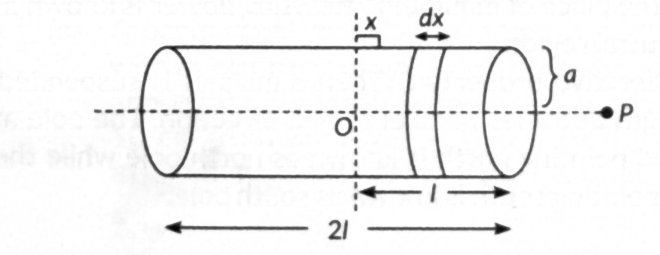
Diagram to draw: a solenoid of length and radius drawn horizontally, its centre marked ; an element of thickness shaded at a distance to the right of ; the axis extended to an external point at a distance from , so the element is from ; the current direction and the resulting axial at marked with arrows.
Take turns per unit length and current . The element of thickness carries turns. Using the axial field of a circular loop,
Integrating over the whole solenoid,
For a far external point, and , so and
This is identical in form to the far axial field of a bar magnet, so a current-carrying solenoid behaves like a small bar magnet, and the magnetic moment of a bar magnet equals that of the equivalent solenoid producing the same field.
Magnetic moment of a coil
- The direction is normal to the plane of the coil, given by the right-hand rule: curl the fingers along the current, and the thumb points along . For a coil lying in the - plane, is along the -axis.
- Worked value CBSE has set: , , gives , directed perpendicular to the plane of the coil.
Far field of a bar magnet — the electrostatic analogue
Comparing the dipole equations with those of Chapter 1, the magnetic results follow from the electric ones by the replacements , , . For :
| Quantity | Electrostatics | Magnetism |
|---|---|---|
| Constant | ||
| Dipole moment | ||
| Equatorial field, short dipole | ||
| Axial field, short dipole | ||
| Torque in an external field | ||
| Energy in an external field |
- At equal distances , and the two are oppositely directed.
The dipole in a uniform magnetic field
Diagram to draw: a small magnetic needle of moment inclined at to a uniform field shown as parallel horizontal lines; equal and opposite forces on the two ends forming a couple; the angle marked between and . The same arrangement, with the needle set oscillating, is used to measure either or .
- Torque: , magnitude . It is a restoring torque.
- Net force: zero. The two poles feel equal and opposite forces in a uniform field, so there is a couple but no translation.
- Potential energy, obtained by integrating the work done against the restoring torque:
Taking the constant of integration as zero fixes the zero of potential energy at , i.e. with the needle perpendicular to the field.
| Orientation | Torque | Potential energy | Equilibrium | |
|---|---|---|---|---|
| Along the field | (minimum) | stable | ||
| Perpendicular | (maximum) | not an equilibrium | ||
| Opposite the field | (maximum) | unstable |
- Work done by an external agent turning the magnet from to :
- Worked value CBSE has set: , , starting at . Turning to gives ; turning to gives ; and the torque in the final orientation is .
Pivoted magnet held at an angle
- A magnet on a frictionless pivot is held at to the field by a force applied perpendicular to its axis at distance from the pivot. Balancing the deflecting and restoring torques,
- Worked value CBSE has set: , , , gives .
- If is withdrawn the magnet is no longer in equilibrium: the restoring torque makes it oscillate about the field direction and, because of damping, it finally comes to rest aligned along .
Standard results to carry into the exam
- ; for a solenoid .
- , (opposite to ), for .
- , in a uniform field.
- ; ; , .
- Cutting a magnet transversely or lengthwise both give two magnets, each with an N and an S pole.
- Not every magnetic configuration has poles: a toroid, or a straight infinite conductor, has no net magnetic moment and no poles.
- To find which of two identical bars is the magnet using nothing else: bring the end of bar A to the middle of bar B. A magnet's field is strongest at its ends and weakest at the centre, so if there is no force at the middle of B, then B is the magnet. Repulsion in any orientation proves both are magnetised; attraction always means one is unmagnetised.
Theory Questions Asked on This Subtopic
Real board questions. Answers are at the end of the page.
- 1
Assertion (A): The poles of a bar magnet cannot be separated. Reason (R): Magnetic monopoles do not exist.
- (a)
Both Assertion (A) and Reason (R) are true and Reason (R) is the correct explanation of the Assertion (A).
- (b)
Both Assertion (A) and Reason (R) are true, but Reason (R) is not the correct explanation of the Assertion (A).
- (c)
Assertion (A) is true, but Reason (R) is false.
- (d)
Assertion (A) is false and Reason (R) is also false.
- (a)
- 2
Write the four important properties of the magnetic field lines due to a bar magnet.
- 3
A bar magnet of magnetic moment is aligned at with a uniform external magnetic field of . Calculate (a) the work done in turning the magnet to align its magnetic moment (i) normal to the magnetic field, (ii) opposite to the magnetic field, and (b) the torque on the magnet in the final orientation in case (ii).
- 4
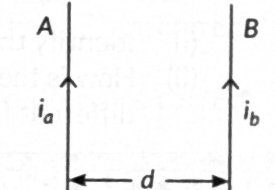
(a) Derive the expression for the force acting between two long parallel current-carrying conductors. Hence, define 1 A current. (b) A bar magnet of dipole moment rests with its centre on a frictionless pivot. A force is applied at right angles to the axis of the magnet, from the pivot. It is observed that an external magnetic field of is required to hold the magnet in equilibrium at an angle of with the field. Calculate the value of . How will the equilibrium be affected if is withdrawn?
- 5
(a) Show that a current-carrying solenoid behaves like a small bar magnet. Obtain the expression for the magnetic field at an external point lying on its axis. (b) A steady current of flows through a circular coil having turns of radius . The coil lies in the - plane with its centre at the origin. Find the magnitude and direction of the magnetic dipole moment of the coil.
Numericals
Every numerical set on this subtopic. Full working is at the end of the page.
- 6
A bar magnet has magnetic dipole moment . Its initial position is parallel to the direction of uniform magnetic field . In this position, the magnitudes of torque and force acting on it respectively are
- (a)
and
- (b)
and
- (c)
and
- (d)
and
- (a)
- 7
Which of the following statements is correct?
- (a)
Magnetic field lines do not form closed loops.
- (b)
Magnetic field lines start from the north pole and end at the south pole of a magnet.
- (c)
The tangent at a point on a magnetic field line represents the direction of the magnetic field at that point.
- (d)
Two magnetic field lines may intersect each other.
- (a)
Answers & Solutions
Work the questions above first, then check yourself here. Each answer is set out the way it should be written in the paper.
Magnetic poles cannot be separated because magnetic monopoles do not exist — this is exactly what Gauss's law for magnetism expresses, so (R) is the correct explanation of (A). Gauss's law for magnetism: , which indicates that an isolated magnetic monopole does not exist.
The four important properties of magnetic field lines are: 1. Magnetic field lines are continuous closed curves — outside the magnet they run from the N pole to the S pole, and inside the magnet from the S pole to the N pole. 2. The tangent drawn at any point on a field line gives the direction of the magnetic field at that point. 3. Two magnetic field lines can never intersect each other; if they did, the field would have two different directions at the point of intersection, which is not possible. 4. The magnetic field lines are crowded close together near the poles (where the field is strong) and are widely separated where the field is weak — the degree of closeness represents the relative strength of the field.
Given: , , (a) Work done in turning the magnet, (i) When the magnet is turned normal to the field: , (ii) When the magnet is turned opposite to the field: , (b)
(a) Consider two long, straight, parallel conductors and , carrying currents and respectively, separated by a distance . Magnetic field produced by conductor at any point on conductor : ...(i) (directed perpendicular to ) This field exerts a force on conductor (carrying current ). The force per unit length on is By Newton's third law, exerts an equal and opposite force on . The force is attractive if the currents are in the same direction, and repulsive if they are opposite. Definition of 1 ampere: One ampere is that constant current which, if maintained in each of two straight parallel conductors of infinite length and negligible cross-section, placed 1 m apart in vacuum, would produce between them a force of per metre of length. (b) Given: , , , In equilibrium, the deflecting torque due to equals the restoring torque due to : If is withdrawn, the magnet is no longer in equilibrium. The restoring torque due to makes it oscillate about the field direction for some time, and — due to damping — it finally comes to rest aligned along the direction of the external magnetic field.
(a) A solenoid may be regarded as a combination of a large number of identical circular current loops, each of which behaves like a magnetic dipole. Hence, a current-carrying solenoid behaves like a small bar magnet. Consider a solenoid of length , radius , having turns per unit length and carrying current . Consider a circular element of thickness at a distance from the centre of the solenoid, at an axial point (distance from ). Number of turns in this element . The magnetic field at due to this circular element: Integrating over the length of the solenoid, For a point far away from the solenoid, and , so , and , where is the magnetic moment of the solenoid — identical in form to the axial field of a bar magnet, confirming the solenoid behaves as one. (b) Given: , , Magnetic dipole moment, is directed perpendicular to the plane of the coil (the - plane), i.e., along the -axis — the direction given by the right-hand rule (curl the fingers along the current direction; the thumb points along ).
Since , the angle between them is . Torque, Net force on the dipole , as the forces on the two poles of the magnet are equal in magnitude and opposite in direction (a uniform field exerts no net force on a dipole).
The direction of the magnetic field at any point is given by the direction of the tangent drawn at that point on the magnetic field line. Note (common mistake): Magnetic field lines are continuous closed curves, not discontinuous ones starting at N and ending at S. Outside the magnet the lines run from the N pole to the S pole, while inside the magnet they travel from the S pole to the N pole, so each line forms a closed loop.