5.5
Magnetic Properties of Materials
Magnetism and Matter · CBSE
Theory
Magnetisation and magnetic intensity — the definitions this section rests on
- A circulating electron in an atom has a magnetic moment. In bulk matter these moments add vectorially and may leave a non-zero total.
- Magnetisation, the net magnetic moment per unit volume:
is a vector with dimensions , measured in .
- Take a long solenoid, turns per unit length, current . With no core the interior field is . Fill the interior with a magnetised material and the field becomes
where is the contribution of the core and is the same constant that appears in the Biot-Savart law.
- Magnetic intensity (magnetising field) is defined by
has the same dimensions and units as , namely .
- The split is deliberate: carries the external cause (the current in the windings, inside a solenoid), while carries the material's own response.
- For a linear material the response is proportional to the cause:
, the magnetic susceptibility, is a dimensionless measure of how the material responds. It is small and positive for paramagnetic materials, and small and negative for diamagnetic materials — in the latter case and point in opposite directions.
- Substituting back,
is the relative magnetic permeability, the magnetic analogue of the dielectric constant; is the permeability, with the units of . Only one of , , is independent — given any one, the other two follow.
- Worked pattern (NCERT Example 5.5): a solenoid with , , . Then ; ; ; and from , the magnetising current is .
Classification by susceptibility
A material is diamagnetic if is negative, paramagnetic if is positive and small, and ferromagnetic if is large and positive.
| Diamagnetic | Paramagnetic | Ferromagnetic |
|---|---|---|
Here is a small positive number. Typically for a diamagnet and for a paramagnet — a minuscule difference in produces radically different behaviour.
Diamagnetism
- Definition: diamagnetic substances are those which tend to move from the stronger to the weaker part of an external magnetic field. Where a magnet attracts iron, it repels a diamagnetic substance.
- Origin: the resultant magnetic moment of an atom of a diamagnetic substance is zero in the absence of a field — the orbital moments of the electrons cancel.
- On applying a field, electrons whose orbital magnetic moment is along the field slow down, and those opposed speed up. This is an induced-current effect, in accordance with Lenz's law. The substance therefore develops a net magnetic moment opposite to the applied field, and is repelled.
- Field pattern: the lines are repelled or expelled and the field inside the material is reduced — in most cases by about one part in .
- In a non-uniform field the bar moves from high field towards low field.
- Examples: bismuth, copper, lead, silicon, nitrogen at STP, water, sodium chloride.
- Diamagnetism is present in all substances, but it is so weak that paramagnetic or ferromagnetic effects usually swamp it.
- Superconductors are the most exotic diamagnets: metals cooled to very low temperatures showing both perfect conductivity and perfect diamagnetism. The field lines are completely expelled, and . This perfect diamagnetism is the Meissner effect. A superconductor repels a magnet and, by Newton's third law, is repelled by it — the basis of magnetically levitated superfast trains.
Paramagnetism
- Definition: paramagnetic substances are those which get weakly magnetised when placed in an external magnetic field, and tend to move from a region of weak field to a region of strong field — they are weakly attracted.
- Origin: each atom, ion or molecule possesses a permanent magnetic dipole moment of its own. Ceaseless random thermal motion keeps these moments disordered, so no net magnetisation is seen without a field.
- In a sufficiently strong field, and at low temperature, the individual atomic dipoles align along . Increasing the field or lowering the temperature raises the magnetisation until it reaches its saturation value, at which point every dipole is perfectly aligned with the field.
- Field pattern: the lines get concentrated inside the material and the field inside is enhanced — in most cases by about one part in .
- Examples: aluminium, sodium, calcium, oxygen at STP, copper chloride.
- Both and depend not only on the material but also on the sample temperature, through Curie's law:
with the absolute temperature in kelvin and the Curie constant. Worked pattern the board has set: magnesium with at reaches at .
Ferromagnetism
- Definition: ferromagnetic substances are those which get strongly magnetised when placed in an external magnetic field, and have a strong tendency to move from a region of weak field to a region of strong field — they are strongly attracted.
- Origin: the atoms carry permanent dipole moments as in a paramagnet, but they interact so that they spontaneously align in a common direction over a macroscopic volume called a domain. (Explaining the cooperative effect needs quantum mechanics and is beyond the syllabus.) A typical domain is about across and contains around atoms.
- Initially each domain has its own magnetisation, oriented randomly from domain to domain, so there is no bulk magnetisation. On applying the domains turn towards and, at the same time, the domains already oriented along grow at the expense of the others, until the sample becomes one giant aligned domain. Domain motion is not speculation — it can be watched under a microscope after sprinkling a liquid suspension of powdered ferromagnetic material on the sample.
- Field pattern: the field lines are highly concentrated inside the material; in a non-uniform field the sample moves strongly towards the region of high field. The relative permeability exceeds .
- Hard ferromagnets keep their magnetisation after the external field is removed — alnico (an alloy of iron, aluminium, nickel, cobalt and copper) and the naturally occurring lodestone. These are used as permanent magnets, for example as compass needles. Substances that retain their ferromagnetic property at room temperature for a long period are permanent magnets.
- Soft ferromagnets lose their magnetisation as soon as the external field is removed; soft iron is the standard example.
- Ferromagnetic elements: iron, cobalt, nickel, gadolinium.
- Temperature: the ferromagnetic property depends on temperature. At a high enough temperature the domain structure disintegrates and the ferromagnet becomes a paramagnet; the disappearance of magnetisation with temperature is gradual. Above the Curie temperature ,
- Permeability of a ferromagnet is not a constant. Since and tends towards saturation as is increased, decreases when the magnetising field is increased. The relation between and is non-linear.
- Beyond these three classes there also exist ferrimagnetic, anti-ferromagnetic and spin-glass materials.
Comparison table for the three- and five-mark answers
| Property | Diamagnetic | Paramagnetic | Ferromagnetic |
|---|---|---|---|
| Susceptibility | small, negative, | small, positive, | large, positive, |
| Relative permeability | |||
| Atomic dipole moment with no field | zero | permanent but randomly oriented | permanent, aligned within domains |
| Magnetisation relative to | opposite | along | along, and very large |
| Effect on field lines | expelled, field weakened inside | drawn in, field slightly enhanced | strongly concentrated inside |
| In a non-uniform field | strong region to weak region | weak region to strong region | weak region to strong region, strongly |
| Temperature dependence | almost none | paramagnetic above | |
| Examples | bismuth, copper, lead, silicon, water, sodium chloride | aluminium, sodium, calcium, oxygen, copper chloride | iron, cobalt, nickel, gadolinium, alnico |
Diagram: field lines through a specimen
Draw a uniform horizontal field as equally spaced parallel lines with arrows, and place a rectangular bar in the middle.
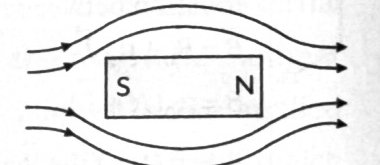
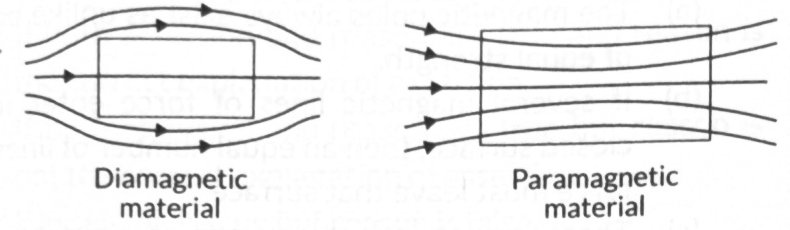
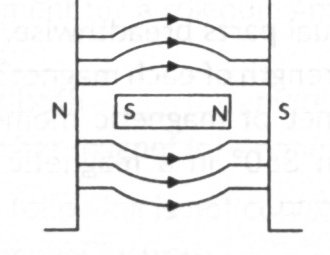
- Diamagnetic bar: the lines bend away from the bar and go round it, so inside the bar they are fewer and more widely spaced than outside. The specimen expels the field and is weakly repelled.
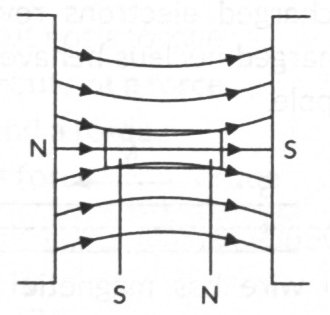
- Paramagnetic bar: the lines bend towards the bar and crowd through it, so inside the bar they are closer together than outside. The specimen draws the field in and is weakly attracted.
- Ferromagnetic bar: the same as paramagnetic but far more pronounced — almost all the lines in the neighbourhood are funnelled through the specimen.
- The explanation to write underneath: the difference is one of relative permeability. For a diamagnetic substance ( negative), so the lines of force do not prefer to pass through it; for a paramagnetic substance ( positive), so the lines of force prefer to pass through it.
Identifying a material from a single number
| Given | Deduce | Material |
|---|---|---|
| diamagnetic | ||
| , negative | diamagnetic | |
| small and positive | paramagnetic | |
| (copper) | just below | diamagnetic |
| over | very large | ferromagnetic |
- Copper, water, silicon, sodium chloride and bismuth are diamagnetic; aluminium, sodium and copper chloride are paramagnetic; nickel and alnico are ferromagnetic. These exact substances appear in the board's one-mark options.
- A diamagnetic substance is the one whose permeability is less than that of free space, and the only one whose relative permeability lies between and .
Points that decide one-mark questions
- Magnetic field lines are repelled by a diamagnetic substance.
- Diamagnetic atoms have no resultant magnetic moment in the absence of an external field; paramagnetic atoms do.
- A diamagnetic specimen moves from stronger field to weaker field; a paramagnetic specimen moves from weaker field to stronger field.
- Above the Curie temperature a ferromagnetic material becomes paramagnetic — not diamagnetic.
- Increasing the magnetising field on a ferromagnet decreases its permeability, because saturates while keeps rising.
- Diamagnetic susceptibility is essentially independent of temperature; paramagnetic susceptibility follows .
Theory Questions Asked on This Subtopic
Real board questions. Answers are at the end of the page.
- 1
The magnetic field lines are ______ by a diamagnetic substance.
- 2
The magnetic susceptibility of magnesium at is . At what temperature will its magnetic susceptibility become ?
- 3
The magnetic susceptibility of a given material is . Identify the magnetic material.
- 4
Write one important property of a paramagnetic material.
- 5
Do the diamagnetic substances have a resultant magnetic moment in an atom in the absence of an external magnetic field?
- 6
In what way is the behaviour of a diamagnetic material different from that of a paramagnetic material, when kept in an external magnetic field?
- 7
Depict the behaviour of magnetic field lines in the presence of a diamagnetic material.
- 8
Relative permeability of a material . Identify the nature of the magnetic material and write its relation to magnetic susceptibility.
- 9
Two identical bars, one of paramagnetic material and the other of diamagnetic material, are kept in a uniform external magnetic field parallel to it. Draw diagrammatically the modifications in the magnetic field pattern in each case.
- 10
Give two points to distinguish between a paramagnetic and a diamagnetic substance.
- 11
Write three points of differences between para-, dia- and ferro-magnetic materials, giving one example for each.
- 12
The susceptibility of a magnetic material is . Identify the type of magnetic material. Draw the modification of the field pattern on keeping a piece of this material in a uniform magnetic field.
- 13
Show diagrammatically the behaviour of magnetic field lines in the presence of (i) paramagnetic and (ii) diamagnetic substances. How does one explain this distinguishing feature?
Numericals
Every numerical set on this subtopic. Full working is at the end of the page.
- 14
Which of the following has its permeability less than that of free space?
- (a)
Copper
- (b)
Aluminium
- (c)
Copper chloride
- (d)
Nickel
- (a)
- 15
Which of the following cannot modify an external magnetic field as shown in the figure?
- (a)
Nickel
- (b)
Silicon
- (c)
Sodium Chloride
- (d)
Copper
- (a)
- 16
Which one of the following has relative magnetic permeability between 0 and 1?
- (a)
Aluminium
- (b)
Alnico
- (c)
Water
- (d)
Sodium
- (a)
- 17
Above the Curie temperature, a
- (a)
ferromagnetic material becomes diamagnetic
- (b)
ferromagnetic material becomes paramagnetic
- (c)
paramagnetic material becomes ferromagnetic
- (d)
paramagnetic material becomes diamagnetic
- (a)
Answers & Solutions
Work the questions above first, then check yourself here. Each answer is set out the way it should be written in the paper.
Repelled.
For a paramagnetic material, Curie's law gives
Since the magnetic susceptibility is negative, the material is diamagnetic (diamagnetic materials have small, negative, temperature-independent susceptibility).
A paramagnetic material has a small, positive magnetic susceptibility () and gets weakly magnetised in the direction of the applied field — it tends to move from a region of weaker field to a region of stronger field. (Any one correct property suffices.)
No. In diamagnetic substances, the individual atoms/molecules have no net (permanent) magnetic dipole moment in the absence of an external magnetic field.
A diamagnetic specimen tends to move from a region of stronger magnetic field to a region of weaker magnetic field (it is weakly repelled), whereas a paramagnetic specimen tends to move from a region of weaker magnetic field to a region of stronger magnetic field (it is weakly attracted).
In a diamagnetic material, the magnetic field lines are pushed out (repelled), so they become less dense inside the material than outside — the material weakens the field within it.
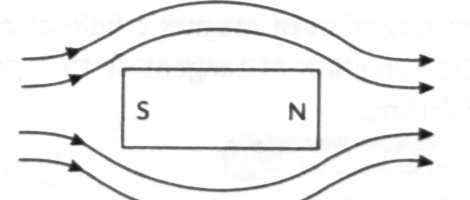
Since (i.e., is negative), the material is diamagnetic.
In the diamagnetic bar, the field lines are pushed out and become less dense inside the material (the lines bend away from the bar). In the paramagnetic bar, the field lines are pulled in and become denser inside the material (the lines bend towards and crowd into the bar).
The question is a real board question. Its answer and working are ours — this paper was published without an official answer key.
Definitions
- **Paramagnetic substance:** a substance which gets weakly magnetised **along** the direction of an external magnetic field, and which tends to move from a region of weak field to a region of strong field — it is weakly attracted by a magnet.
- **Diamagnetic substance:** a substance which gets weakly magnetised **opposite** to the direction of an external magnetic field, and which tends to move from a region of strong field to a region of weak field — it is weakly repelled by a magnet.
Two points of distinction
Point Paramagnetic substance Diamagnetic substance Susceptibility and permeability is small and **positive**, , so and is small and **negative**, , so and Behaviour in a non-uniform field Moves from the weaker to the stronger part of the field; the field lines are drawn into the specimen, so inside is slightly greater than outside Moves from the stronger to the weaker part of the field; the field lines are pushed out of the specimen, so inside is slightly less than outside Atomic magnetic moment with no field applied Each atom has a **permanent** magnetic moment, but the moments are randomly oriented, so the net moment is zero The resultant magnetic moment of each atom is **zero**; a moment is induced only when a field is applied Effect of temperature Obeys Curie's law, — the magnetisation is destroyed by thermal agitation as rises Practically independent of temperature Examples aluminium, sodium, calcium, oxygen at STP, copper chloride bismuth, copper, lead, silicon, water, sodium chloride Any two of the above rows are enough for the three marks; the first two are the ones the marking scheme always accepts.
The question is a real board question. Its answer and working are ours — this paper was published without an official answer key.
Three points of difference
Property Diamagnetic Paramagnetic Ferromagnetic Magnetic susceptibility small and negative, small and positive, large and positive, Relative permeability , often above Behaviour in a non-uniform field weakly repelled; moves from the stronger to the weaker part of the field weakly attracted; moves from the weaker to the stronger part of the field strongly attracted; moves from the weaker to the stronger part of the field Atomic dipole moment with no external field zero — the orbital moments of the electrons cancel permanent, but randomly oriented, so no net moment permanent, and already aligned within domains Magnetisation relative to opposite to , and very small along , and small along , and very large Effect of field lines expelled from the specimen, inside is reduced drawn into the specimen, inside is slightly increased strongly concentrated inside the specimen Effect of temperature essentially independent of temperature obeys Curie's law, becomes paramagnetic above the Curie temperature , with **Example** bismuth (also copper, lead, water) aluminium (also sodium, calcium, oxygen at STP) iron (also cobalt, nickel, gadolinium) Answer
Any three of the property rows above, written together with one example of each class, earn the full three marks. The safest three to quote are:
- i. **Susceptibility:** is small and negative for a diamagnetic, small and positive for a paramagnetic and large and positive for a ferromagnetic substance.
- ii. **Behaviour in a non-uniform field:** a diamagnetic is weakly repelled and moves towards the weaker field, a paramagnetic is weakly attracted and moves towards the stronger field, and a ferromagnetic is strongly attracted and moves towards the stronger field.
- iii. **Effect of temperature:** a diamagnetic is unaffected, a paramagnetic follows Curie's law , and a ferromagnetic turns paramagnetic above its Curie temperature.
Examples: bismuth (diamagnetic), aluminium (paramagnetic), iron (ferromagnetic).
Since (small and positive), the material is paramagnetic. The field lines are pulled in and crowd into the material (denser inside than outside), since a paramagnetic material is weakly attracted into the field.
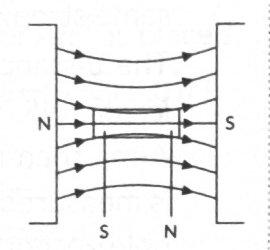
(i) Paramagnetic substance — the field lines crowd into (concentrate within) the material: (ii) Diamagnetic substance — the field lines are pushed out of (become sparse within) the material: Explanation: This distinguishing feature arises from the difference in their relative permeabilities. The relative permeability of a diamagnetic substance is less than 1 ( negative), so magnetic lines of force do not prefer to pass through it. The relative permeability of a paramagnetic substance is greater than 1 ( positive), so magnetic lines of force prefer to pass through it.
Copper is diamagnetic, so its relative permeability is slightly less than that of free space (i.e., ).
Copper is diamagnetic, so the magnetic field lines tend not to pass through it and it cannot noticeably modify the field pattern shown, unlike nickel (ferromagnetic) or silicon/sodium chloride which respond more visibly to the applied field.
Water is diamagnetic and has a relative magnetic permeability between 0 and 1 (i.e., ).
Above the Curie temperature , thermal agitation destroys the alignment of domains in a ferromagnetic material, and it behaves as a paramagnetic material, following the Curie-Weiss law: (for )